The Risk in a Scattered Job Search Is Not Being Rejected. It Is Getting Through.
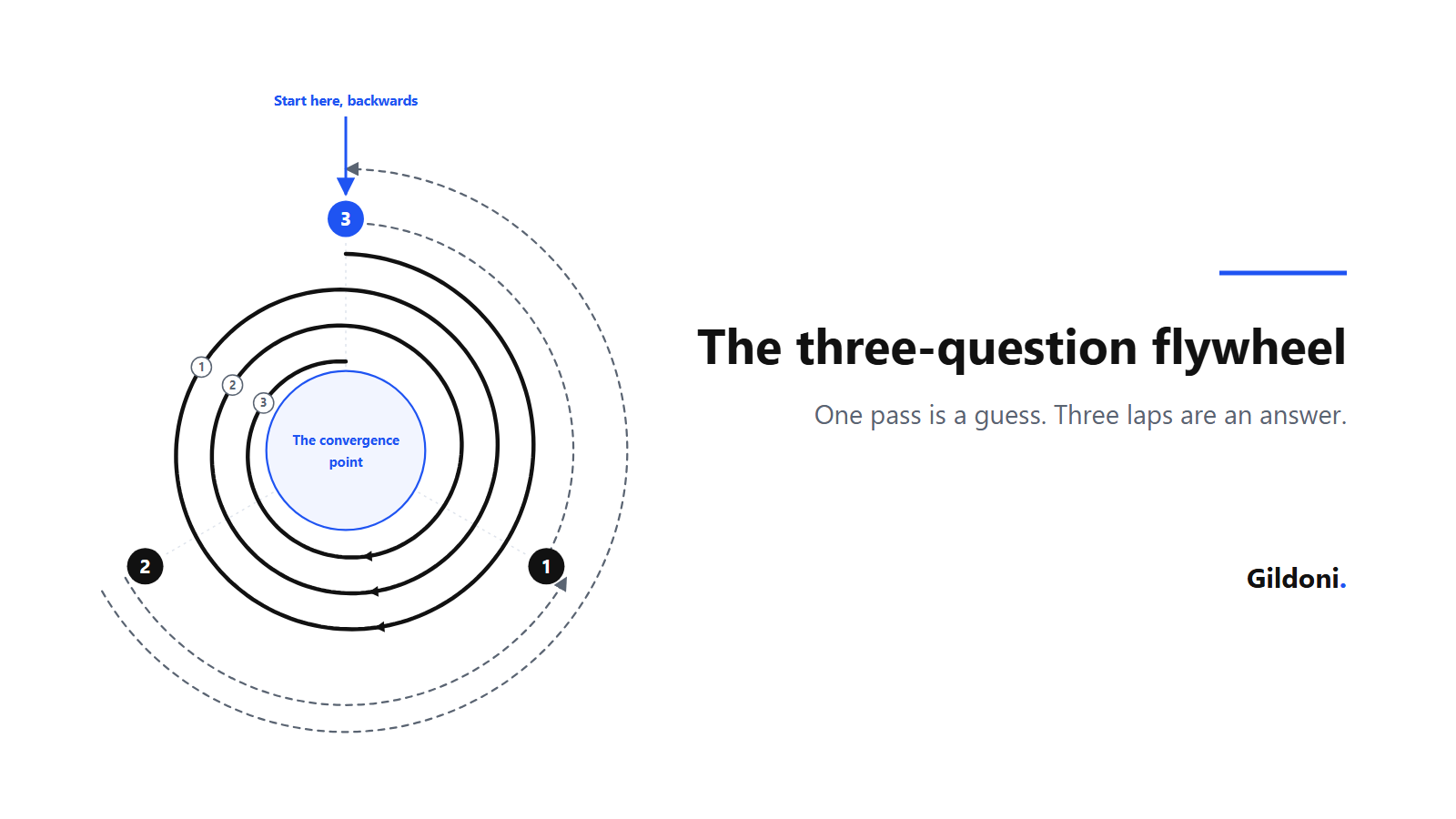
The short version, if you are in a hurry. Every open role now draws hundreds of applications, sometimes thousands. The instinct is to apply more, and wider, and that is exactly the mistake. Not because you are not good, but because breadth cannot be verified and specificity can. And the real risk is not the one you are thinking about: it is not being rejected, it is getting through. Clearing five processes and landing somewhere you never chose. What follows is three questions most of us answer in the wrong order, and what happens when you start with the last one instead.
“So what are you going to be when you grow up?”
The last time anyone asked you that seriously you were seven, and you had an answer. Astronaut. Vet. Goalkeeper.
Thirty years have passed since then, a whole career, maybe a relocation. Nobody asks any more. But notice something strange: most of us still have no answer. There are roles we have filled, skills that have piled up, a tidy LinkedIn profile. An answer, no.
And usually that is completely fine, because nobody demands one. Until a single moment arrives, a redundancy, a move to another country, a market that shifts, and puts the question from age seven on the desk of a forty-two year old.
And then you find out what kind of market it lands in.
Two hundred and forty-two.
That is how many applications an open role draws today. Not an unusual role: an ordinary one. And a role written broadly, or at a company people want to work for, goes past a thousand.
Think about that from your side for a second. You send a CV, and it lands in one pile with hundreds of other people, every one of them quietly convinced they are the right fit. The question that asks itself is how on earth you stand out of that.
And the instinctive answer is to apply more. And not only more, also wider.
Which is where a conversation begins that I have again and again, in almost the same words.
“Which roles have you applied for?”
“Everything. Look: product manager. Customer success. Account manager. Solutions engineering. Sales engineering. Backend too, I still write code. Some cloud. Marketing I am genuinely good at, I did it for two years. I was also thinking about something in the AI direction, I build those tools myself. BDR, SDR, whatever you like.”
And then comes the most important line in the whole conversation:
“I don’t see any problem with that. I really am good, and I really can do all of those things.”
And the truth? He is right. I believe him completely. In most cases he is not exaggerating by a single word, and if I had to pick someone for my own team I would be glad to take him.
And still, one question remains, and it is the question this whole article is trying to answer:
Good. So now what? How do you take all of that and say it to one person, in a way that makes them want you specifically?
The other side of the compliment
If you recognised yourself in that list, I have news: you are not unusual. You are, fairly precisely, the Israeli average.
For fifteen years we have been told the same story. Start-up nation. Responsibility at twenty, improvisation, initiative, a small economy where nobody can afford to do only one thing, and a culture in which changing role every three years is ambition rather than instability. A well-oiled machine for producing people who can do a great deal.
That story has always been told from one side: the founder’s. How wonderful it is to be that person when you are building a company.
Nobody ever bothered to tell it from the other side. From the side of someone who is building nothing, but is sitting in front of a job ad in Amsterdam trying to explain themselves to a Dutch employer.
Because there, that exact same trait stops being an asset and becomes a liability.
Why a liability? Because breadth cannot be checked
An employer who is hiring does not buy breadth. Not out of narrow-mindedness, but for a simple economic reason: breadth cannot be verified, specificity can. The claim “I am good at a lot of things” gives them no cheap way to test it, so it never enters the calculation. The claim “I built this thing, it worked, here are the numbers” they can test in one conversation. The demand for specificity is risk management, not a lack of imagination.
And that is where the asymmetry appears that leaves excellent people outside: the person offers breadth, the employer buys depth, and neither of them is wrong.
Before we go on, one landmine that keeps circulating. No, the ATS is not throwing your CV in the bin before a human has seen it. The famous number, that seventy-five percent are never seen, traces back to a marketing claim by one company in 2012, which closed a year later.
But there is one thing the system does do, and almost nobody tells you about it: it remembers. You applied, you were rejected, and it was recorded. And in the Netherlands that is more serious than it sounds, because here it is not a software matter at all, it is a policy matter. A Dutch hiring process is obliged to treat every candidate in exactly the same way, so an exception in favour of one particular person simply does not exist. I have watched this happen more than once: a candidate rejected at an early stage, sometimes automatically, and later a senior manager wants them and there is nothing to be done. The door does not open again. Not on a better CV, not on an introduction, and not because someone senior enough is convinced.
Sometimes that fairness is the most unfair thing you can imagine.
And the Dutch market differs from the American one in the other direction too, contrary to most of the posts that reach your feed. The UWV puts it precisely like this: the shortage of ICT people has narrowed, and it is still large. More than a hundred thousand open IT roles, and demand growing faster than supply.
But look at the wording, because it is the whole difference: employers’ difficulty is selective, not general. They are not struggling to hire people. They are struggling to hire the particular person who solves a particular problem for them. The door is not locked. It is just not being handed the right key.
Now put those two things side by side, because together they change the arithmetic. The door is not locked, but it locks behind you. Which means every scattered application can close a company to you, permanently, without you noticing and without you having chosen it. So no, sending fifty CVs did not cost you one evening. It cost you fifty companies, and you picked them at random.
Three questions, and one unexpected direction
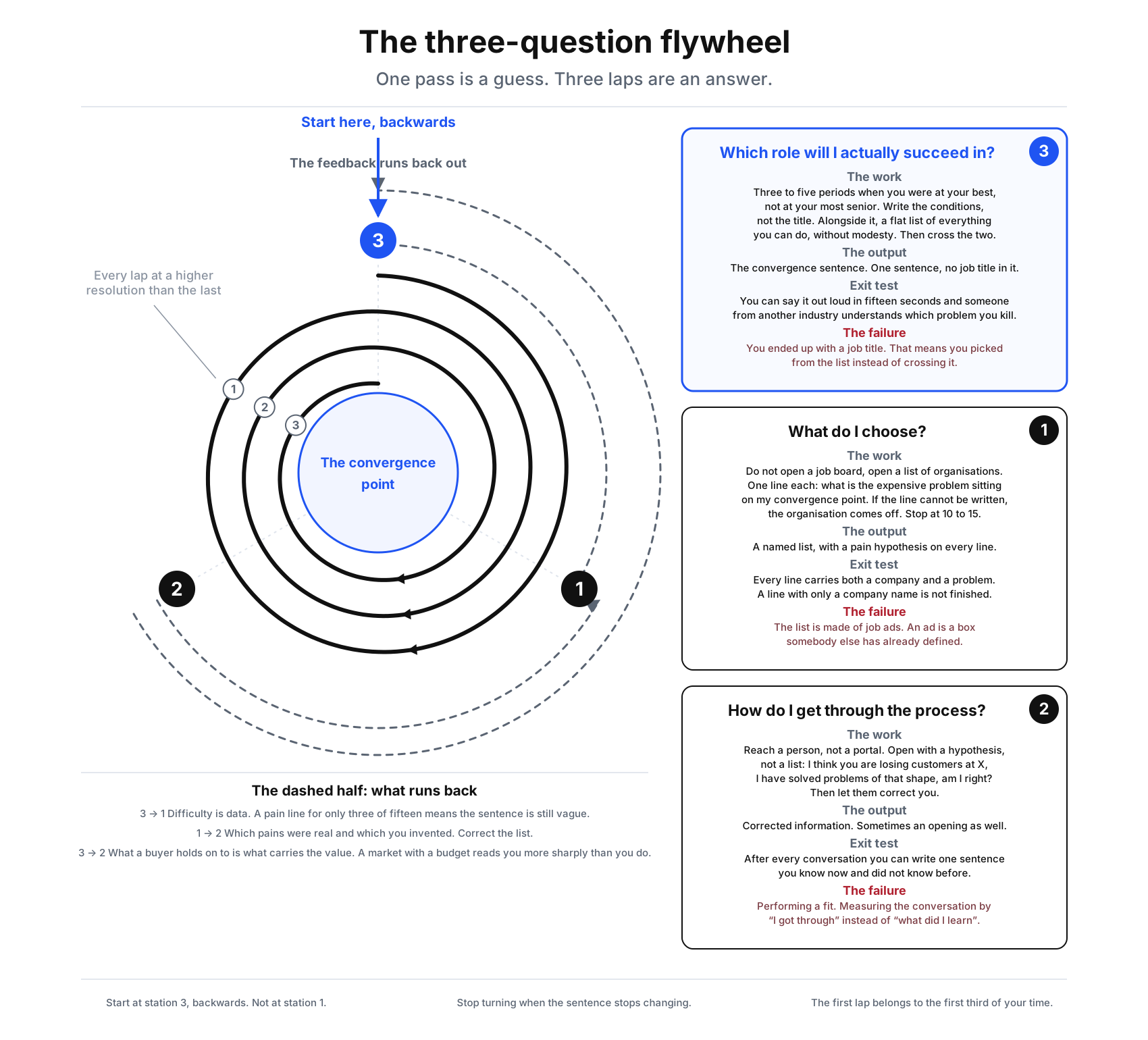
I work with three questions. Most people know them, but answer them in order, or worse, answer only the middle one:
One: what do I choose. Two: how do I get through the process. Three: how do I succeed in the role.
My claim is that they are not a ladder but a flywheel, and that you drive it from the end.
And the difference between a flywheel and an ordinary wheel is not semantic. An ordinary wheel turns as long as you push it and stops when you stop. A flywheel stores what you put into it and hands it back, so that every turn makes the next one easier. That is not a pretty image for three bullet points. It is a claim about mechanics: a good answer to one question does not stay with that question, it moves to the other two.
Most people postpone the third question, because it feels like a problem for after the signature. But when you turn it around, it becomes the most important of the three: instead of “how will I succeed in the role”, ask “in which role will I actually succeed, and which gaps would have to close”.
And when you answer it seriously, it does not hand back a general answer. It hands back a point. Here is how to find it.
The list is not the answer. It is the raw material
Someone who can do many things presents themselves as a list. That is the mistake, and it looks entirely reasonable.
The problem with a list is that every line in it is a crowded market. You are an engineer, and there are tens of thousands more. You have run a team, and there is plenty of that too. You worked for years in a particular field, and you are not the only one. On each line separately you are one of many. And so the genuinely cruel thing happens: the longer the list, the better it proves how easy you are to replace.
The exercise is not to pick from the list. It is to cross it.
Two questions do the work. The first: which of the things on the list would you do even if nobody paid you. The second, and this is the hard one: where is the organisation whose most expensive problem sits exactly at the point where three of them meet.
Here is what that looks like in practice.
An engineer who also ran a small team and also spent four years on systems that are not allowed to fall over. Separately: thousands of engineers, thousands of team leads, a great many infrastructure people. At the intersection: one person you can hand both the stability of the product and the people responsible for it. Who is bleeding there? A company growing fast that is starting to lose customers to outages.
An operations and logistics manager who taught himself to analyse data and speaks three languages. Separately: three entirely common professions. At the intersection: someone who can look at a European supply chain, understand why it bleeds differently in each country, and talk to both the warehouse in Poland and the supplier in Italy. Who is bleeding there? Any company that has just entered three markets and discovered that all three behave differently.
A designer who spent two years in technical support and can write. Separately: three saturated fields. At the intersection: a person who understands why users drop off in the second week, because he answered their calls. Who is bleeding there? A B2B company with a strong product and an onboarding process that loses half of its sign-ups.
Notice what happened in all three. Nobody gave anything up. Nobody made themselves smaller. The list stayed completely intact, it just stopped being a list.
And from here the wheel turns on its own
Once there is a point, the three questions start feeding each other.
The first question, what to choose, stops being a guess. You are no longer choosing out of fog, you are reading the choice off the conditions in which you succeed.
And the second question lifts by itself. “I am good at a lot of things” is a claim that cannot be tested. “I am the person who sits exactly at the point where your pain is” is tested in one conversation. Someone interviewing at a place they genuinely fit interviews differently from someone performing a fit. It is no longer another interview to survive. It is a conversation about a problem you know how to solve.
And notice something. The question you turned around, “in which role will I actually succeed”, is exactly the question the employer is asking about you. “Who do I need for this to work.” The same question, two sides of the same table. Someone running the wheel backwards is not fighting the demand for specificity. They are doing, for the employer, the work the employer is already trying to do, and doing it better, because they have access to the data.
And then, once you are in, comes the part nobody tells you in advance. The breadth that made you hard to sell is exactly what will make you good in the role. Someone who knows three worlds sees the connections nobody else in the room sees, talks to three departments in their own language, and spots a problem before it arrives. That is not a bonus. That is the definition of seniority.
The trait did not change between the two stages. Only its timing.
A last word on the risk
Someone spread across many processes at once is sure their risk is rejection. It is not. Capable people get through processes, that is what they are good at. The real risk in a scattered search is getting through: clearing five processes and landing somewhere you never chose. The search succeeded, and the decision was never made.
Rejection costs two weeks. A role you did not choose costs years. And that sits with a familiar finding in the research on regret: in the short term we regret what we did, in the long term what we did not.
So if you are in the middle of it, here is where to start, and it asks nothing of you beyond one evening. Write your full list, without modesty and without editing. Mark what you would do even if nobody paid you. Then look for the point where three of them meet, and ask who it hurts enough to pay for. If what came out is a job title, you went back to picking from the list instead of crossing it. Start again.
You do not need hundreds of opportunities. You need one that you chose.
And the question from age seven turns out to have an answer after all. It simply was never the name of a single profession. It is the point where everything you have become meets.